
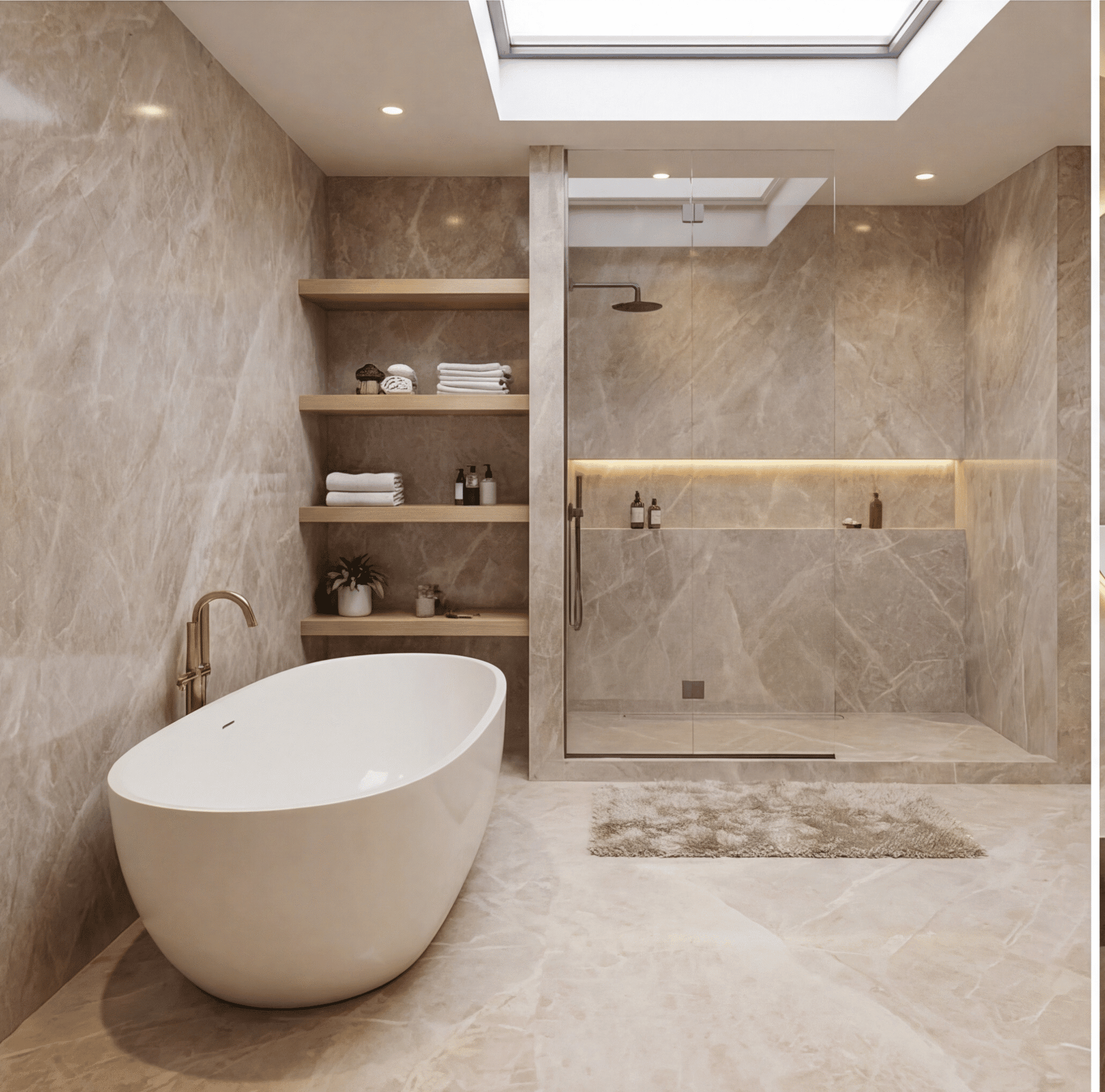
Floors
Visual uniformity across large spans — ideal for lobbies and broad living rooms.

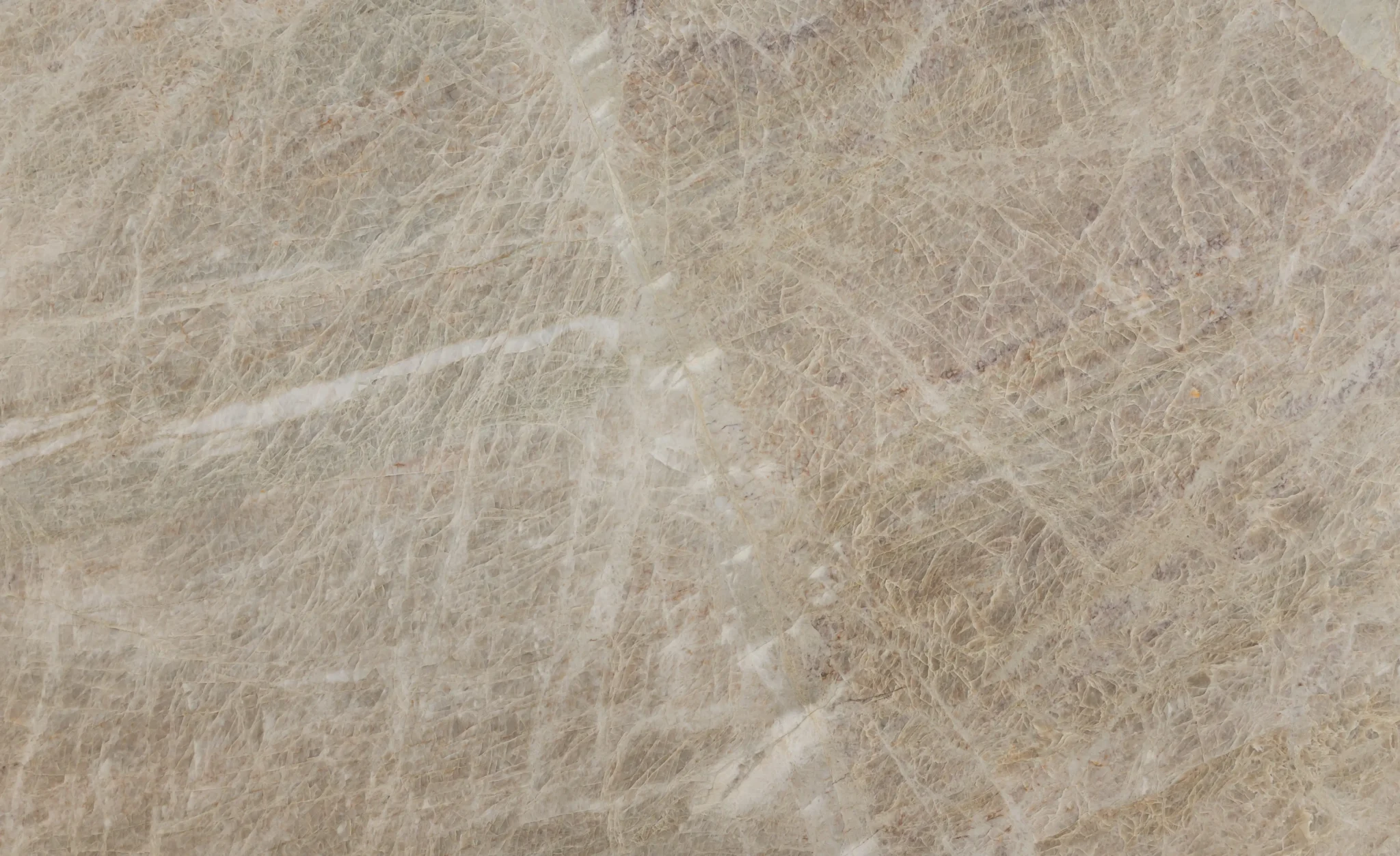
Where geological patience meets the project's gesture.
Cream tones, a firm soul, a silent presence.
Belvedere is a quartzite with a beige background, crossed by reddish veining that recalls ancient mineral traces. Its massive granoblastic structure and fine-to-medium granulation deliver a continuous surface, with no visible cavities — a clean plane where light distributes without noise.
Resistant to time and touch, it is specified by architects and stone fabricators seeking sophisticated neutrality: a stone that dialogues with wood, brushed metal, linen, and light marble without competing for attention.
 Pattern · profile views
Every Belvedere slab brings together the tones of the earth — from serene ivory to the iron-red of mineral veining, through warm sands and taupes.
Visual uniformity across large spans — ideal for lobbies and broad living rooms.

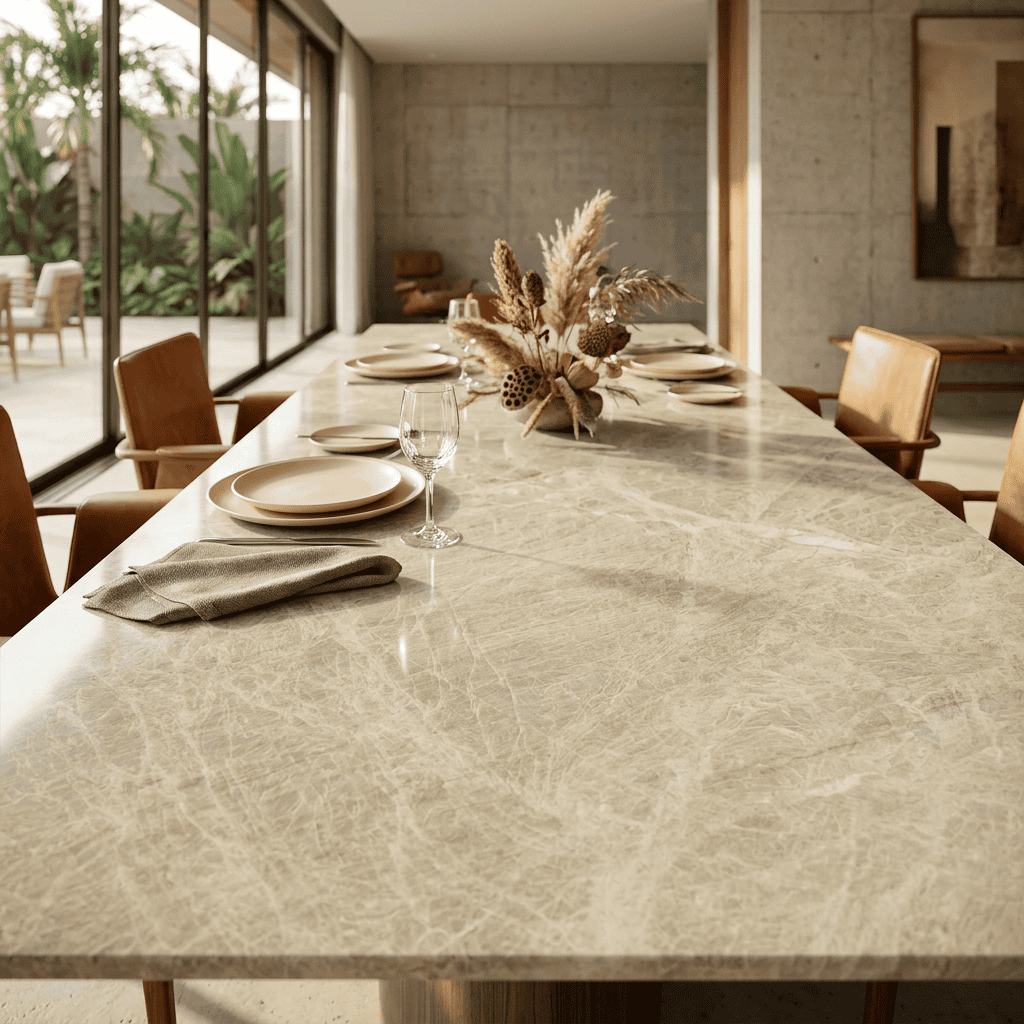
Countertops, panels, and claddings that demand continuity and quiet elegance.

Low absorption (0.26%) favors bathrooms, powder rooms, and kitchens with proper sealing.

Freeze/thaw coefficient K = 0.85 — stable behavior on façades and patios.
Each Belvedere slab carries a unique signature. Our intent is to provoke new perceptions and expand your vocabulary of combinations in kitchens, dining rooms, floors, and bathrooms.
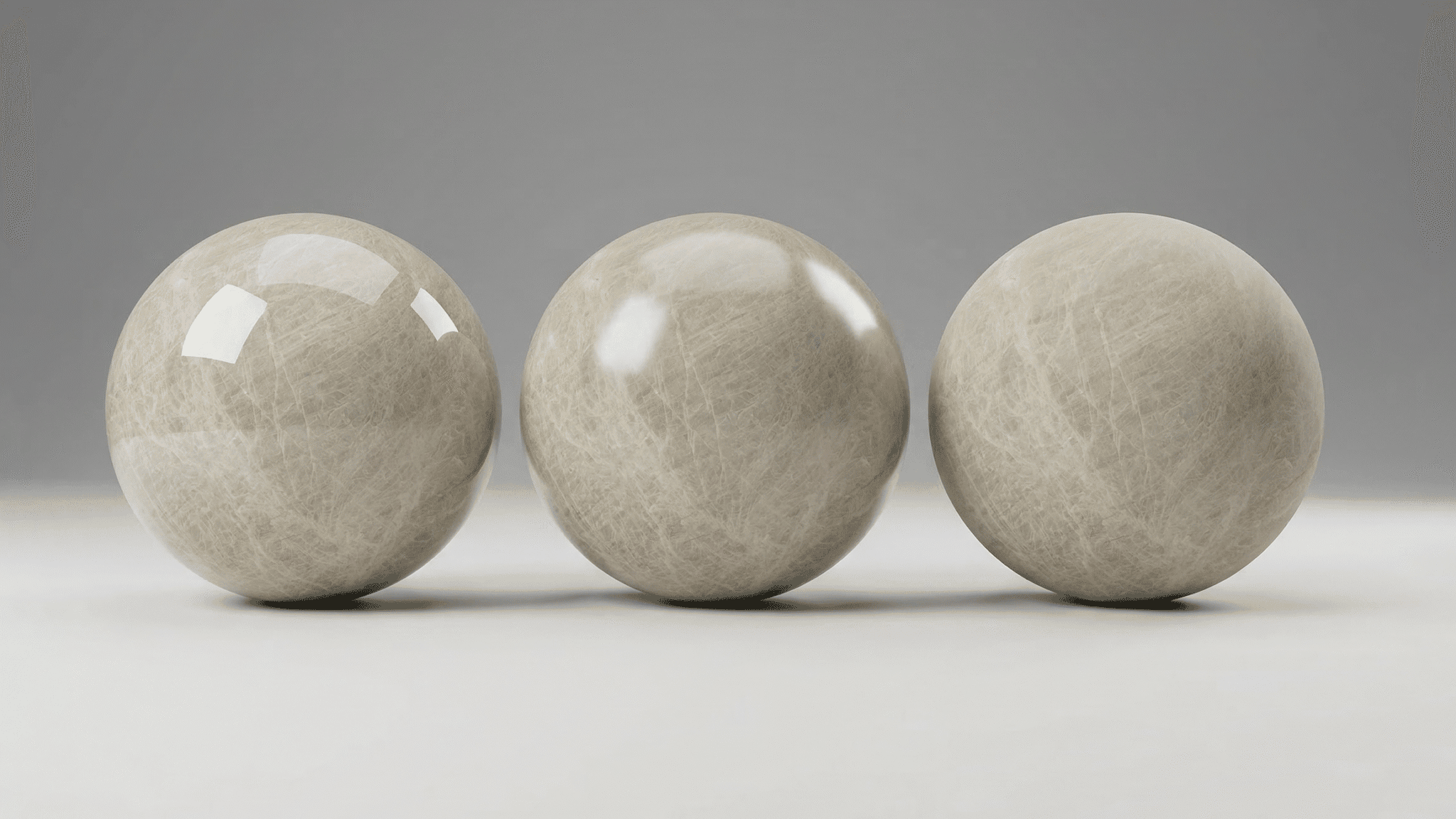
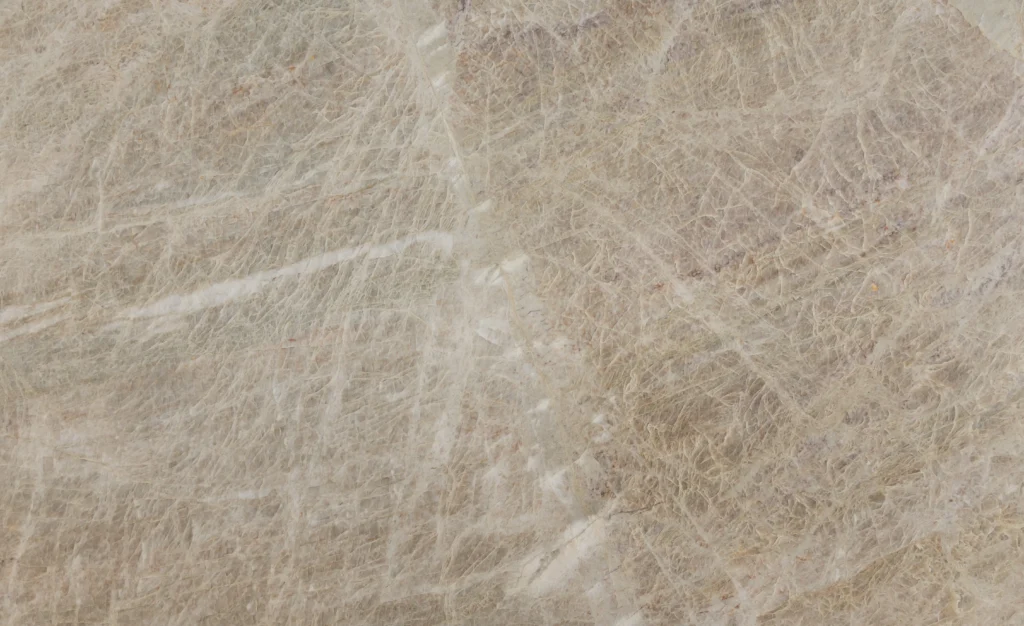
For use in presentations, moodboards, and renderings.
Quartzite (metamorphic rock) with a beige pattern and reddish veining. Tests performed according to ABNT NBR 15845 (applicable parts) and ABNT 12042/2012. Laboratory: ATLAS Rock Mechanics.
Microscopically: massive granoblastic quartzite, composed predominantly of quartz (~99%) with opaques (~1%) forming oxidized red-ferruginous veins in the interstices. Low degree of intergranular microfracturing. Macroscopically: beige with reddish veins, granoblastic texture, fine-to-medium granulation, no observed cavities/pores, no significant weathering.
The combination of porosity ~0.69% and absorption ~0.26% positions Belvedere as a low-absorption material, favoring performance in wet areas with proper specification and maintenance: less tendency to absorb liquids, better response to sealers, and greater predictability in use.
The results indicate good suitability for slabs and pieces, provided the project takes into account thickness, span, supports, and fastening — particularly for countertops, stairs, and claddings. For relevant spans, the decision rests with the designer or the project's engineer, considering geometry, layout, and reinforcements.
After freeze/thaw cycles, it retains 85% of its natural strength (96.97 MPa). In hard-body impact, the average is 0.50 m for fissure and 0.55 m for rupture — reinforcing the importance of proper supports, setbacks, and well-dimensioned edges. Average values obtained at the ATLAS Rock Mechanics laboratory, report nº 202505270.
Validation of structural design and fastening by the engineer of record is always recommended, considering natural variations between batches and slabs.
Belvedere is a quartzite: a natural stone with Mohs hardness 7, highly scratch-resistant and low in porosity. Because it is natural — not engineered quartz — it needs periodic sealing and a gentle cleaning routine to keep its shine for years.
A soft microfiber cloth or non-abrasive sponge, warm water, and neutral detergent. Always dry after cleaning and wipe up spills right away.
Seal with a quality water-repellent, reapplied every 6 months to 2 years depending on use — the barrier that repels liquids and eases cleaning.
Heat-resistant, but thermal shock can cause micro-cracks. Always use trivets — never rest a hot pan directly on the stone.
Don't cut directly on the surface — it dulls both the shine and your knives. Use a cutting board and avoid dropping heavy objects.
After installation, wait about 24h before using the surface (curing of adhesives and sealants). Always check the instructions from your quartzite's manufacturer and the fabricator responsible for specific guidance.
Receive a physical sample, schedule a showroom visit, or speak with a Milgran specialist to clarify any technical questions about the material.
"Belvedere is the kind of stone that ages along with the house — discreet, precise, timeless."
— Milgran Curation